
Clinical TRials
We are working to support PWS clinical trials
PWS Stronger Together are working with the pharmaceutical industry to support clinical trials in the UK. We will provide regular updates on progress of the trials.
Currently Recruiting in the UK

Harmony - The TEMPO Clinical Trials
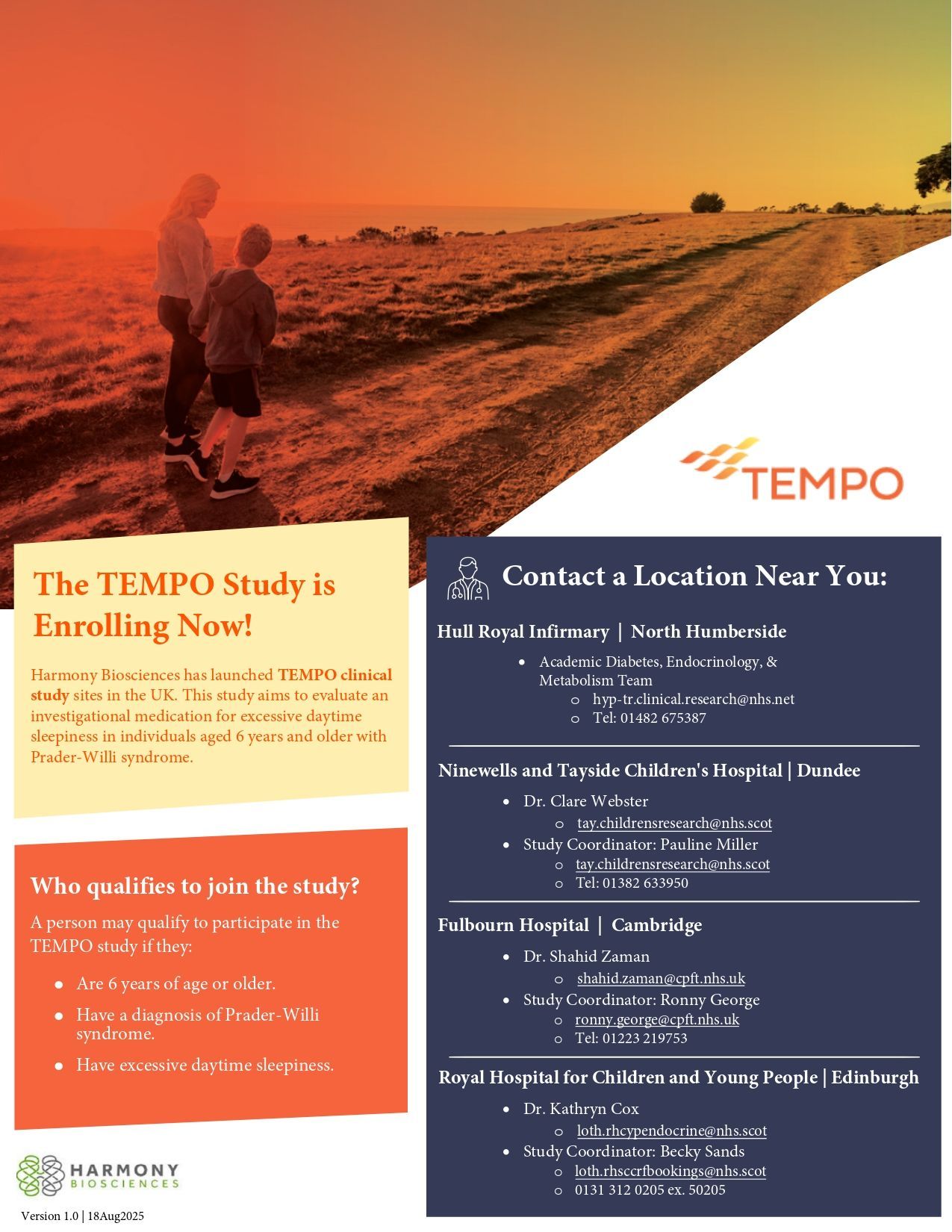
The TEMPO clinical trial is assessing an investigational medicinal product for excessive daytime sleepiness (EDS) in people aged 6 years or older with PWS and is seeking volunteers.
What is this Trial about?
This study will assess whether an investigational medicinal product is safe and effective compared with placebo (a tablet/pill with no medicine in it). Researchers want to assess its impact on the severity of excessive daytime sleepiness in people aged 6 years or older who have PWS. They also want to assess its impact on the severity of irritable and disruptive behaviour and on hyperphagia (excessive eating).
Harmony Biosciences are being assisted in recruitment for this trial by Leapcure. The Leapcure team are supporting the TEMPO study by helping families determine whether the individual living with PWS may be eligible to participate and offering 1-on-1 support to answer questions.
Connect with a dedicated Leapcure team member and learn more by starting with this quick questionnaire: https://lpcur.com/tempo-pwsuk
Aardvark Therapeutics - Ard-101
The HERO Clinical trial investigated whether ARD-101 could help reduce excessive hunger and food-seeking behaviours in people with PWS by stimulating the release of specific gut hormones.
The HERO Study was placed on a voluntary pause by Aardvark Therapeutics and subsequently subject to a clinical hold by the FDA to address safety concerns. During this time, the company is unblinding the study data. This means researchers will be able to identify which participants received ARD-101 and which received a placebo, providing further information about both the treatments safety and its potential effectiveness.
Prior to the current hold, Aardvark Therapeutics had opened clinical trial sites in the UK, including London, Glasgow, Cambridge and Leicester. Eligibility criteria included a confirmed diagnoses of Prader-Willi Syndrome and an age of 10 years or older.
PWS Stronger Together will continue to share updates as more information becomes available. Please also continue to follow FPWR UK and PWSA UK for future announcements.
Harmony Biosciences are being assisted in recruitment for this trial by Leapcure. The Leapcure team are supporting the TEMPO study by helping families determine whether the individual living with PWS may be eligible to participate and offering 1-on-1 support to answer questions.
Connect with a dedicated Leapcure team member and learn more by starting with this quick questionnaire: https://lpcur.com/tempo-pwsuk
Learn More About Upcoming Trials

The TEMPO clinical trial is assessing an investigational medicinal product for excessive daytime sleepiness (EDS) in people aged 6 years or older with PWS and is seeking volunteers.

Harmony Biosciences is testing a drug called pitolisant to help people who struggle with excessive daytime sleepiness (EDS) caused by certain medical conditions. They are running clinical trials to see if this drug can help people stay more awake and alert during the day.

HERO
ARD-101 is an investigational oral medication that has been evaluated in clinical trials as a potential treatment for Prader-Willi Syndrome (PWS). The HERO Study is currently on voluntary pause and under FDA clinical hold whilst additional safety information is assessed.

ARD-101 is an orally administered small molecule designed to activate specific receptors in the gut, promoting feelings of fullness and reducing excessive hunger. By stimulating the release of hormones like CCK and GLP-1, ARD-101 aims to address the persistent hunger experienced by individuals with PWS.

ConSynance Therapeutics is developing CSTI-500, an oral medication aimed at treating PWS.
Phase 2 trials have begun in the USA

CSTI-500 works by increasing levels of three brain chemicals—serotonin, dopamine, and norepinephrine—to help manage these symptoms.

Was DCCR, now VYKAT XR
Soleno Therapeutic's trial of the drug DCCR for hyperphagia is now complete and approval has been granted in the USA (under the name VYKAT XR).

Soleno had previously submitted an application to the European Medical Agency (EMA) for the hopeful approval of VYKAT XR/DCCR in the European Union. Since Soleno’s acquisition by Neurocrine Biosciences this application has been withdrawn.
We will keep you informed as soon as we hear any more information.

Update from acadia pharmaceuticals
Compass - PWS Carbetocin Trial
Acadia Pharmaceuticals has shared the results of their Phase 3 COMPASS PWS clinical trial, which tested a potential treatment for hyperphagia in people with Prader-Willi syndrome (PWS). Sadly, the results showed that the treatment did not significantly reduce hyperphagia compared to a placebo, and Acadia has decided not to continue developing this drug.
The trial involved 175 children and adults with PWS aged 5-30 from all over the world, including here in the UK. Participants received intranasal carbetocin 3 times a day for 12 weeks and their outcomes were measured on a questionnaire called the Hyperphagia Questionnaire for Clinical Trials (HQ-CT). The results showed there was no significant improvement in hyperphagia in the group taking the drug compared to the group taking the placebo (the non-medicative comparable drug). The safety of the drug was not an issue with a low rate of adverse effects, but as the drug was not showing a significant enough improvement in hyperphagia Acadia have had to come to the decision to not pursue their investigations any further.
This news is understandably disappointing for our community, especially for those who took part in the trial. However, we want to take a moment to thank the researchers who worked hard on this study, and most importantly, the individuals and families who took part. Your involvement is incredibly valuable and helps move research forward, even when the outcome isn’t what we hoped for.
If you or your child were part of the trial, and you’re unsure what happens next, please contact your research doctor for advice and support.
Clinical Trial FAQ
How do I hear about clinical trials?
FPWR and PWSA will let everyone know about any trials that open in the UK. We'll announce trials on our social channels and on our websites - so please make sure you follow us and check in regularly on www.pwsstrongertogether.co.uk!
Are trials safe?
The safety of people who take part in clinical trials is the number one priority for all pharmaceutical companies and regulators. Before people with PWS participate in trials, the drug or device will undergo thorough safety testing. In addition, pharmaceutical companies must follow strict safety guidelines, contained within their trial protocol. Safety is continuously monitored throughout the whole trial period.
If we took place in the DCCR trial, are we allowed to take part in other new trials?
Yes. For any trial, you must look at the 'eligibility criteria'. For example, the eligibility criteria for Carbetocin say participants must not have used oxytocin, desmopressin (DDAVP), or tesofensine within six months before starting study treatment.
Do other medical conditions impact if I can take part?
They may. Contact the clinical site, which will be able to discuss your specific medical condition and advise you if you can still take part.
Can we only take part if clinics are local to us or are we allowed anywhere if we are prepared to travel?
Yes. Travel is often reimbursed but check with the site when you contact them initially for confirmation.
Do you need to get buy-in from your endocrinologist before embarking on a clinical trial that involves testing a drug?
You don't need to buy in from your endocrinologist to be part of a clinical trial, but you should let them know you are participating. They will be happy to discuss it with you. If you meet the trial's eligibility criteria, you can take part in the trial.
Do health authorities in the different countries (England, Scotland, Wales etc) all generally approve a drug or is it common for say a drug to be approved in England but not Scotland?
One country's health authority may approve a drug but not another. We are working with each authority to educate them about PWS and are ready to support applications for new drugs
What can we do as parents to get drugs approved after the trial has finished?
Parents, caregivers and other parties, such as your endocrine consultant, can all make a difference. The UK regulator (MHRA) and health authorities (who decide if the drug will be available on the NHS) evaluate the data from the trial to see if the drug has a positive impact, i.e. does it work? However, they also want to hear from people with PWS and their caregivers to understand the challenges they face. Being honest about the struggles your family member with PWS faces every day with, for example, hyperphagia, how it impacts their life, mental health, independence, family life, etc, is critical. Our experiences and anecdotes will help regulators and health authorities understand the huge unmet, urgent need and why we desperately need drugs and treatment.
How do I know if my child has hyperphagia enough to take part? eg food focused but don't seek food. Trial needs them to be experiencing hyperphagia?
It would be best if you discussed this with the clinical site. They will know how the trial will assess changes in hyperphagia and be in the best position to advise.
Can I change my mind?
Yes. You can change your mind at any time. Before the trial, you will be provided with all the information you need on the trial. To take part, you'll need to sign a consent form, but you can withdraw your consent at any time.
Does it impact growth hormone treatment?
The clinical site will be able to advise if there's any effect on medications that your family member with PWS may be on.
Is it always the drug or device that comes first? Or is there a patient demand and then the drug is ‘invented’?
A clinical trial looks at the impact a drug OR device has on people who have a particular disease or medical condition. With PWS, a clinical trial may assess if a drug, such as DCCR, reduces hunger. A clinical trial may also evaluate the effectiveness of a device on someone with PWS. For example, the Vagus Nerve Stimulation (VNS) device is currently assessing if it can improve disruptive behaviours and temper outbursts for people with PWS.